




Brief
Define the operation, not just the boundary.
Map user groups, critical zones, normal routes and the exact communication failures that affect the work.

Terrain, structures, interference and real user routes determine what a two-way radio system must overcome.
Radio coverage planning / Malaysia
An RF site survey examines how terrain, structures, interference and real user routes affect two-way radio performance at a specific site. Its findings guide what should be verified before selecting direct, repeater or in-building coverage architecture.

Brief
Map user groups, critical zones, normal routes and the exact communication failures that affect the work.
ILLUSTRATIVE METHOD VISUALS / NO CLIENT OR MEASURED RESULT SHOWN
When the radio path becomes a question
A survey is useful before a new design and when an existing network no longer matches the way the site operates.
Calls weaken or disappear along routes that matter to the operation.
Coverage needs to be planned around new buildings, zones or working patterns.
Basements, reinforced floors, steel and dense interiors interrupt the RF path.
Ridges, distance and changing elevation separate users across the site.
Two starting paths
The first questions change depending on whether the system already exists.
Existing network audit
Trace recurring weak zones, changed conditions and the present RF path before prioritising corrective work.
New system planning
Define who must communicate, where they move and which zones are critical before comparing coverage architecture.
From symptom to decision
Coverage evidence narrows the architecture question while keeping the remaining assumptions visible.
| Observed condition | Survey should inspect | Possible next path |
|---|---|---|
| Local gaps on otherwise compact routes | Obstructions, user position, antenna condition and interference | Direct-system correction or focused retest |
| Separated zones or terrain-shadowed work areas | Line of sight, candidate infrastructure position, power and access | Repeater architecture evaluation |
| Basements, reinforced floors or deep interior rooms | Building attenuation, donor path, risers and indoor antenna zones | In-building coverage evaluation |
| Unstable performance that changes by channel or time | Noise, interference indicators, programming and operating pattern | Further investigation before equipment selection |
Coverage evidence
The exact deliverables depend on the agreed scope. A useful record connects observations to locations, constraints and design decisions.
Survey scope and operating priorities
Agreed routes, zones and observation points
Coverage observations and constraint register
Prioritised next-design recommendations
Assumptions, limitations and commissioning baseline
Engineering boundary
Catalogue range cannot account for every wall, ridge, noise source or user position.
No responsible design should promise universal coverage without project-specific criteria.
After installation, the agreed system still needs field validation and handover evidence.
Questions before the walk
An RF site survey examines how terrain, structures, interference and real user routes affect two-way radio performance at a specific site. It creates evidence for coverage planning before an antenna, repeater or in-building architecture is selected.
A survey should be considered for a new site, an expansion, recurring dead zones, multi-floor or steel-intensive buildings, terrain-separated work areas, changes to operating routes, or an existing radio network that is no longer performing as expected.
Useful inputs include the site plan, building or terrain type, user groups, critical work zones, normal travel routes, current radio equipment and known failure areas. The survey scope can then focus on the decisions the operation actually needs to make.
Dead zones can be influenced by reinforced structures, below-ground areas, terrain, distance, antenna position, feeder losses, interference and where users move during a shift. A catalogue range alone cannot represent all of these site conditions.
Predictive coverage helps compare assumptions and plan where to investigate. A walk test observes performance along real routes and work zones. They answer different questions and are strongest when the model is checked against field conditions.
A survey can provide the evidence used to compare direct radio communication, repeater coverage and in-building distribution. The final architecture also depends on operational priorities, installation constraints, power, access and applicable frequency requirements.
Yes. An existing-network audit can trace recurring failure locations, changed site conditions, interference indicators and the present RF path before corrective options are prioritised.
No generic survey should promise complete coverage without project-specific criteria. The agreed coverage objective, test conditions, assumptions and limitations should be recorded, and the installed system should still be validated during commissioning.
Choose the next service
An RF survey addresses the site and its coverage requirements. For temporary handset hire, start with a rental service.
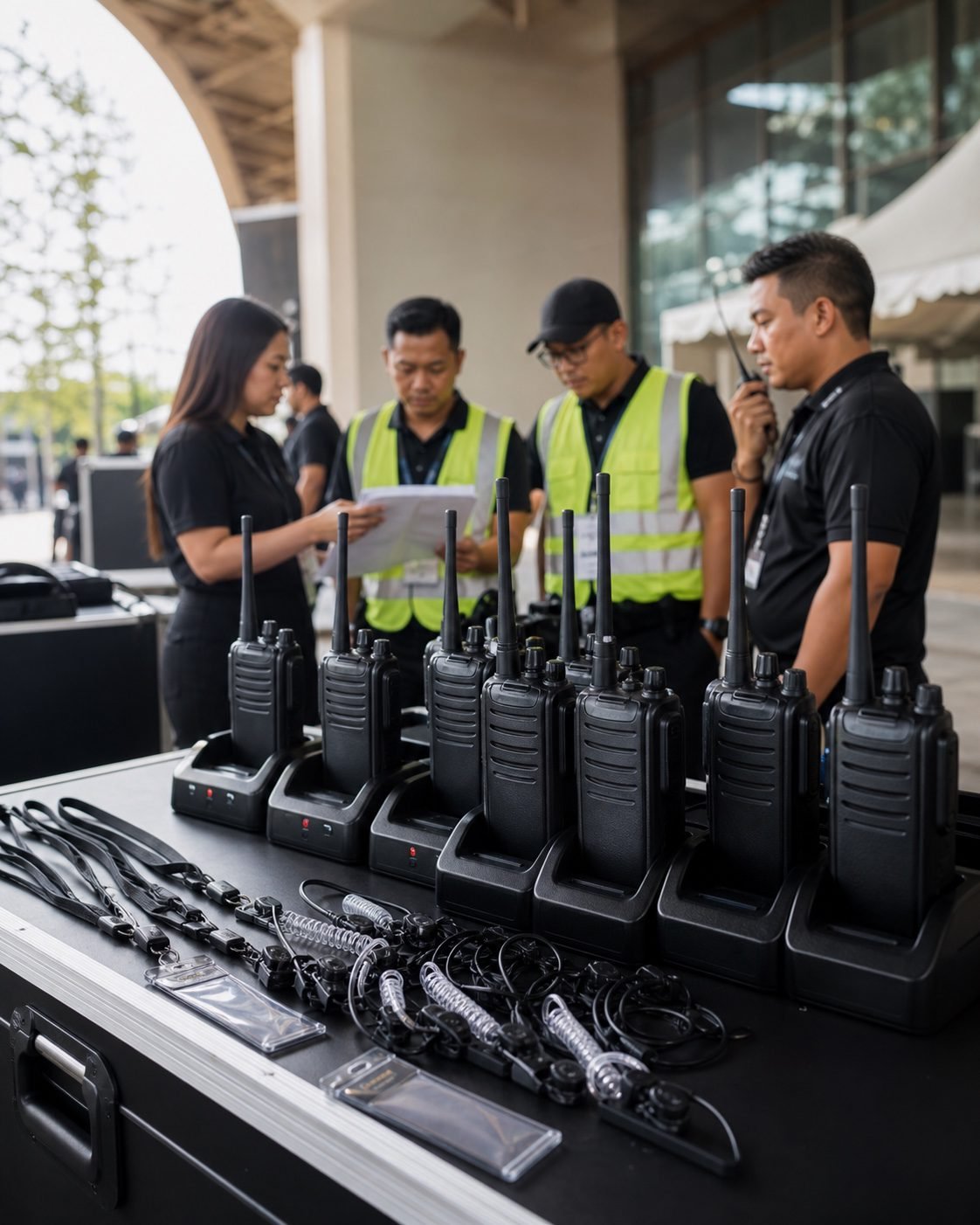
Octogen's rental page provides a separate enquiry route for temporary radio needs. Prepare the quantity, dates and working areas; confirm suitability and availability directly with Octogen.
Octogen: temporary walkie talkie rental
Start with the site
Prepare the site location, building or terrain type, current equipment, user groups, known dead zones and critical routes. We can use that brief to define what needs to be assessed.